
The King Finland Never Chose
How many alternative Europes almost existed?

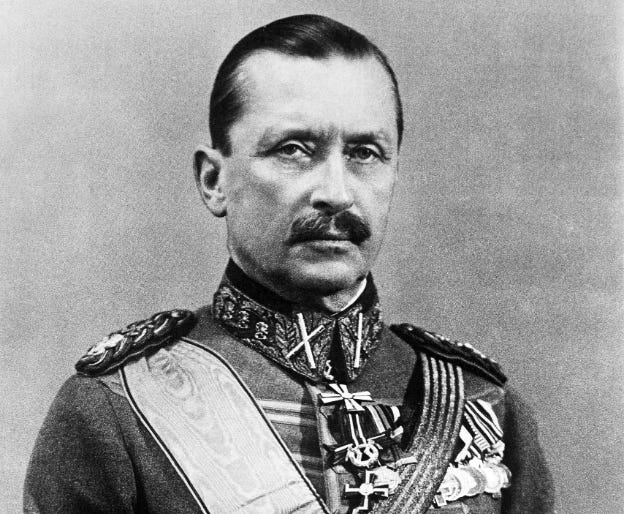
Carl Gustav Emil Mannerheim (1867-1951). The 6th President of Finland and arguably the man with the most impressive life story ever. Someone truly unforgettable, once you read about him.
Early in 2026, I wrote about The King Who Never Arrived.
The story surprised many readers.
In 1918, newly independent Finland elected a German king.
The future monarch never reached his throne.
Germany lost WWI, the political landscape changed overnight, and Finland abandoned the monarchy after its new king abdicated before setting a foot in the country.
The story raises a fascinating question.
What if Finland had chosen somebody else?
History often feels inevitable after the fact.
It rarely is.
When Finland declared independence from the collapsing Russian Empire in 1917, the future remained unwritten.
For more than a century, Finland had existed as the Grand Duchy of Finland within the Russian Empire. The Emperor simultaneously served as Grand Duke of Finland.
Then the Empire collapsed.
The Romanovs fell.
A new nation suddenly had to decide what it wanted to become.
The Finns knew they wanted stability.
They knew they wanted international legitimacy.
They knew they needed protection in a dangerous neighborhood.
What they did not know was which path would best secure those goals.
They eventually chose a German prince.
At the time, the decision made perfect sense.
Germany appeared to be winning the war.
A German king promised prestige, support, and security.
Then Germany lost.
And suddenly Finland’s future king became politically impossible.
But imagine another choice.
Could the Finns have invited a Spanish Bourbon prince?
Spain remained neutral throughout the war.
A Bourbon king in Helsinki sounds improbable today.
Yet in 1918 it was no more improbable than a German king.
Could they have approached Sweden’s Bernadotte reigning dynasty?
After all, Finland had been part of Sweden for centuries before Russian rule.
Could another Romanov prince have been invited?
That possibility may be the most intriguing of all.
For over a century, the Romanovs had been Finland’s monarchs and most Finns had served the Russian Empire loyally.
Among them was Marshal Carl Gustaf Emil Mannerheim—Finland’s most remarkable military leader and later the 6th President of the Republic.
He actually kept a portrait of Tsar Nicholas II in his home until the day he died.
When asked why, he famously replied:
“He was my Emperor.”
Those four words reveal an entire world of loyalties that modern people often struggle to understand.
Imagine a Finland that remained a monarchy under a Romanov branch.
Or under a Bernadotte monarch.
Or a Bourbon.
Or some now-forgotten European dynasty.
The map would look identical.
Yet history might have unfolded very differently.
That is one of the great lessons of history.
Many events we regard as inevitable were anything but.
They resulted from decisions made by people confronting uncertainty and choosing among multiple possible futures.
Most alternative histories begin with wars.
Perhaps they should begin with crowns.
History is filled with kings who never arrived.
And with crowns that were never worn.
One wonders how many alternative histories disappeared with them.
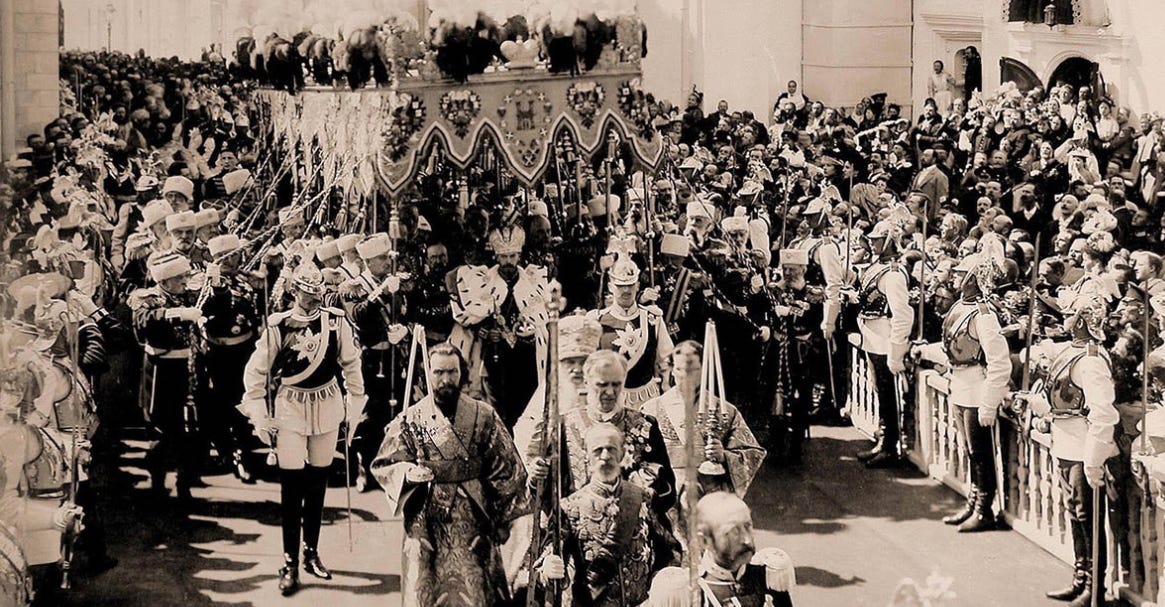
Procession of Russian Tsar Nicholas II at his coronation in 1896. Mannerheim is the Imperial Guard officer marching ahead of the Emperor, on the left of the image.
Want to support ForeignLocal? Become a paid subscriber today… or buy me a coffee here. Thanks much.