
Past and Future Lie in the Desert
Israelis keep discovering civilization in the Negev—and building new one at the same time.

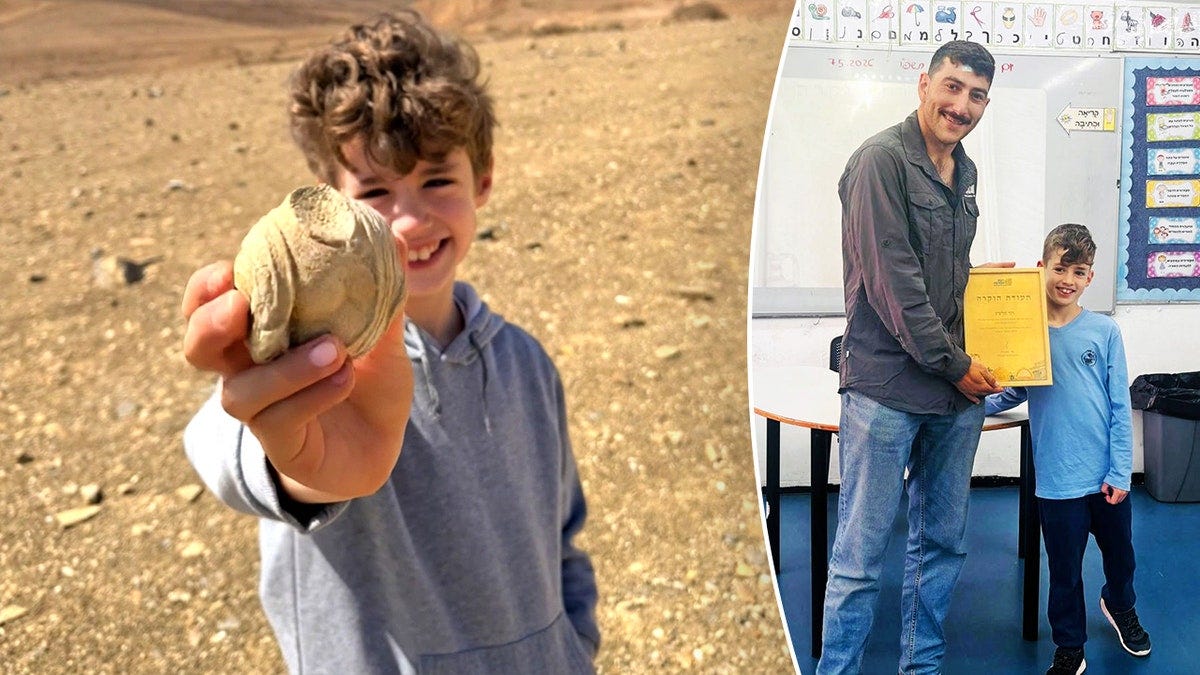
Dor Wolynitz, an 8-year-old from Rehovot, Israel, found the artifact during a visit to the Ramon Crater in the Negev Desert of southern Israel, according to a May 11th release from the Israel Antiquities Authority (IAA).
This post is dedicated to Tzlil Berko, Shelah Horvitz, Karen Hunt aka KH Mezek, Nika Scothorne, Christopher Messina, Uri Kurlianchik and Rocking the suburbs.
Many people look at deserts and see emptiness.
Barren land.
Heat.
Dust.
Isolation.
Survival at best.
Israelis seem to look at the desert differently.
Recently, an 8-year-old Israeli boy walking through the Negev Desert searching for “something interesting” to show his classmates stumbled upon a 1,700-year-old Roman-era statuette fragment lying on the ground.
What first appeared to be an unusual stone turned out to be part of a carefully sculpted ancient figure likely connected either to the Roman god Jupiter or the Nabatean deity Zeus-Dushara.
A tiny fragment of forgotten civilization emerging again from desert sands.
And somehow, that story perfectly captures modern Israel itself.
Because while many voices in the modern West increasingly seem trapped between antisemitism, historical ignorance, and a strange form of suicidal empathy that often advantages those openly hostile to Western civilization, Israel continues doing something remarkable:
building,
innovating,
cultivating,
excavating,
and prospering against all odds.
The same Negev Desert that preserved ancient Roman and Nabatean history beneath its sands is now also becoming the center of futuristic Israeli agricultural experimentation.
Only a short distance from ancient trade routes once connecting Rome and Arabia, Israeli farmers near the Gaza border are now growing blue agave in the desert to produce a uniquely Israeli mezcal spirit.
Yes—Israeli mezcal in the Negev.
And not as a gimmick either.
The project involves millions of dollars in investment, advanced agricultural adaptation, and long-term economic planning in one of the harshest environments in the region.
Even more astonishingly, this development continues despite the trauma of the October 7th Hamas attacks, during which nearby communities suffered genocidal massacres, kidnappings, and devastation.
And yet the response of many Israelis has not been civilizational despair—but reconstruction.
Planting.
Research.
Excavation.
Agriculture.
Entrepreneurship.
Defense.
And life itself.
That contrast matters—more than anything else.
Because civilizations reveal themselves not merely through military power or political slogans, but through what they build under pressure.
The desert remembers civilizations long after civilizations forget themselves.
Romans crossed the Negev.
Nabateans traded across it.
Empires rose and vanished around it.
Ancient gods were buried beneath it.
And now modern Israelis cultivate agave there while preserving one of the richest archaeological patrimonies on Earth.
Many still see deserts as empty places that offer nothing.
Israelis seem determined to prove the exact opposite.
Where others see barren land, they see agriculture, archaeology, innovation, continuity, and future harvests.
Sometimes civilization is not revealed in great speeches or grand ideological theories.
Sometimes it is revealed by what human beings choose to build in the middle of the desert.
And honestly, discussing autochthonous Roman archaeology while sipping Israeli-made blue agave tequila in the near future sounds exactly like the kind of civilizational project that the ideologues of death surrounding Israel will never ultimately be able to defeat.
Am Yisrael Chai!
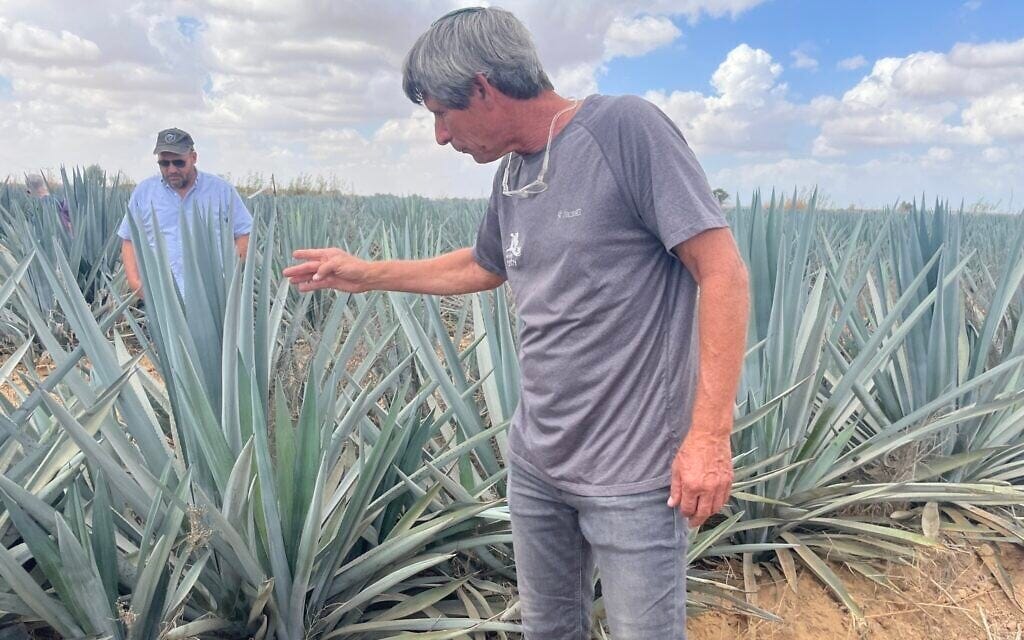
Photo: Eran Braverman, a head farmer from Kibbutz Alumim who helped battle Hamas terrorists on October 7th, fingers one of the blue agave plants grown on the kibbutz for making mezcal, back in September 2024 (TOI).
Israeli farmers ended up importing watery cell tissues of agave from Mexico, where they first grew them in a greenhouse for one year. With a required investment of $5M to produce the first batch of mezcal, they rely on the fact that tequila is the world’s fastest-growing spirit, bigger than vodka or whisky. Proper tequila is a specific type of mezcal made only from blue agave.
Want to support ForeignLocal? Become a paid subscriber today… or buy me a coffee here. Thanks much.
Thank you dear friend! 🤩 I was actually there! Check it out: 🔗 https://tzlilberko.substack.com/p/zionism-baby?r=2sa9r4&utm_medium=ios
I'll drink to that. L'chaim.