
Beer Delivery 4,000 Years Ago
The receipt makes Mesopotamia feel surprisingly familiar...


Four thousand years ago, someone signed for a beer delivery.
Today, we can finally read the receipt.
That simple fact may be one of the most remarkable windows into the ancient world.
Researchers recently analyzed and digitized a clay tablet dating to the Ur III period of Mesopotamia, around 2100 BC. The tablet had spent years sitting largely unnoticed in the archives of Denmark’s National Museum before being reexamined as part of a digitization project.
What did it contain?
A beer receipt.
Not a royal proclamation.
Not military secrets.
Not a lost epic poem.
Beer.
Specifically, the tablet records deliveries of both high-quality and ordinary beer over two consecutive days.
Thousands of years later, it seems people still appreciated premium products.
The quantities involved were substantial.
According to researchers, more than thirty gallons of beer were delivered over the course of two days and received by a provincial governor.
What fascinates me is not only the amount.
It is the normality.
We often view ancient civilizations as distant and almost mythical.
Yet the tiny clay tablet in the Danish museum reminds us that ordinary people then worried about many of the same things we do today.
Inventories.
Deliveries.
Accounting.
Quality control.
Administrative paperwork—claywork?
Somebody had to produce the beer.
Somebody had to transport it.
Somebody had to receive it.
And somebody had to make sure the receipt was properly recorded.
In other words, bureaucracy was already alive and well four millennia ago.
The beer itself was most probably quite different from what we drink today.
Researchers believe Mesopotamian beer was often made from barley and could include ingredients such as date syrup.
It was likely nutritious, relatively low in alcohol, and often consumed through reed straws because of the sediment floating in it.
There is another fascinating detail.
Most people instinctively associate beer with Germany, not with the Middle East.
Yet when this receipt was written nearly 4,000 years ago, German brewing traditions still lay far in the future.
The earliest evidence of beer production comes not from Central Europe but from the great civilizations of Mesopotamia and ancient Egypt.
Another proof that Islam arrived relatively late in the movie.
Long before Bavarian breweries, people living between the Tigris and Euphrates were already producing, delivering, accounting for, and enjoying beer.
But the details of the beverage are almost secondary.
The remarkable thing is that a simple administrative record survived.
Empires rose and fell.
Cities were destroyed.
Dynasties vanished.
Languages disappeared.
Yet a beer receipt endured.
For four thousand years.
Perhaps that is the greatest lesson of archaeology.
The ancient world was not populated by abstract historical figures.
It was populated by people like us today.
People who worked.
People who kept records.
People who enjoyed a drink after a long day.
And thanks to one forgotten clay tablet—who knows if it would still be alive hadn’t Danish archeologists taken it to Copenhagen many decades ago— we can still raise a glass to them today.
It’s nice to be able to think of the Middle East outside the realm of conflict.
Here’s to our beer-drinking ancestors.
Cheers.
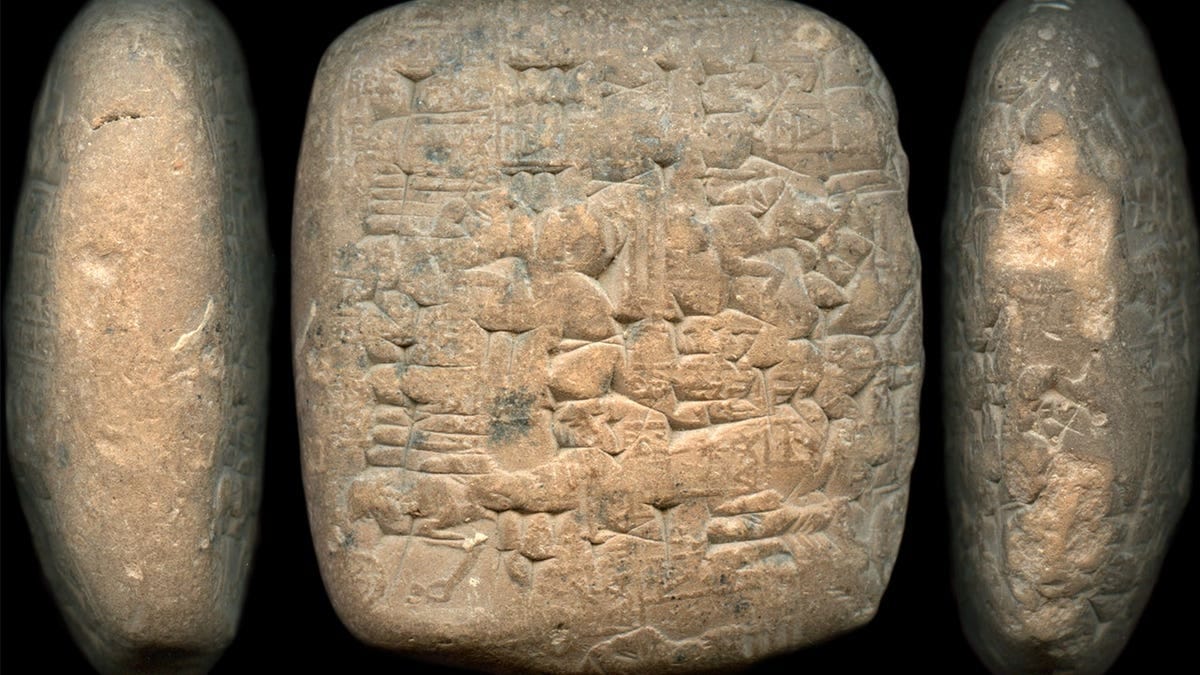
The ancient clay tablet NMC 7962, shown above, details the deliveries of both high-quality and ordinary beer over two successive days in Mesopotamia. (National Museum of Denmark, photo by Troels Arboll).
Want to support ForeignLocal? Become a paid subscriber today… or buy me a coffee here. Thanks much.
Beer was a hugely important development! Because you need to boil water to make beer, it was the first thing humans came up with that was actually safe to drink. Water often came with dysentery or cholera, but beer wouldn’t kill you. Lower alcohol, or “small beer” was given to children to drink, well into the 17th century.
This is my favorite kind of object! Relatedly, I recommend Ian Gately’s “Drink: a Cultural History of Alcohol” which has a great section of the importance of alcohol to early civilizations. Also Mary Beard’s “Pompeii” which discusses Pompeii’s bar scene.